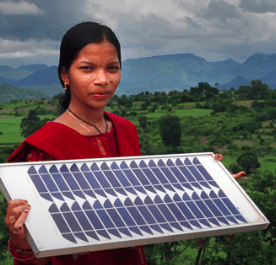
Launched in January of 2016, The Business and Development Commission makes the case for achieving a sustainable economy that will also address environmental issues. The Commission helps businesses align with the Global Goals, and track the economic gains of adhering to these goals.
Because of the importance of addressing climate change for women worldwide (as well as for all other manner of human and other species), it is important to take note of the economic activity that other countries are poised to engage in as a result of the Paris Accord. It’s also important to note how the U.S. will miss out on these economic opportunities because of our current poor (and non-representative) presidential leadership.
The report, created from data produced by the Organisation for Economic Co-operation and Development (OECD), shows where member countries rank in providing funding for gender equality and women’s empowerment.
Another day, another fascinating report on the status of gender equality philanthropy. Today I came across the report, Aid in Support of Gender Equality and Women’s Empowerment, and read about how the United States stacks up against other Development Assistance Committee (DAC) member nations in terms of funding gender equality.
The data shows that as of 2014, the U.S. was the largest supporter of gender equality and women’s empowerment among the DAC membership. The report shows that of the $40.2 billion committed to gender equality and women’s empowerment, the U.S. was responsible for $26,211,000 of that. Second behind the U.S. is Japan, with a total of $16,817,000 in total aid screened. (It’s a complicated mix of ways this money is calculated, so you should look at the notes in the report to get an accurate sense of what they mean by “total aid screened” and other terms.) Third behind Japan in total aid screened is EU Institutions, with a total of $16,312,000.
My first instinct in taking in this data is to wonder whether, with Trump as President, the U.S. will remain a top funder internationally of gender equality and women’s empowerment. It doesn’t seem likely, given the significant cuts that have already been made to the UNFPA. Trump’s decision to cut $32.5 million from the UNFPA’s budget is one that will absolutely devastate worldwide efforts to help women with services as basic as safe childbirth and shelter for abused women. From CNN:
The decision “could have devastating effects on the health of vulnerable women and girls and their families around the world,” said Secretary-General Antonio Guterres through a spokesman.
Guterres “deeply regrets the decision by the United States to cut financial support for the UN Population Fund (and) believes that the decision is based on an inaccurate perception of the nature and importance of the work done by UNFPA,” said his spokesman Stephane Dujarric.
In Syria, UNPFA said it has helped an estimated 48,000 women with safe childbirth, some 74,700 individuals with gender-based violence outreach, and offered health services and psychological support. It has created 64 women’s centers and safe spaces.
That’s not good. With an estimated 222 million women in the world who still lack access to contraceptive services, this appears to be a rather cutthroat way to downsize movements for equality worldwide.
Since its launch in May of 2016, I have started following Ellevate Network on my Twitter feed, and I am always impressed by the quality of their material on both gender equality and gender lens investing. Now, the new startup that aims to capture the $11 trillion women’s investing market, is holding a conference in June to activate gender equality movements. Sallie Krawcheck, the architect and founder of Ellevest, came to my attention last spring when I was creating a list of 9 Gender Lens Investors to Know About.
Sallie Krawcheck, CEO and Co-Founder, Ellevest
Here is my capsule on Krawcheck from that article:
Sallie Krawcheck, CEO and Co-Founder, Ellevest
Known as one of the most senior women on Wall Street, Sallie Krawcheck is a mastermind of finance who has now broken out on her own to make gender lens investing a priority. Formerly president of the Global Wealth and Investment Management division of Bank of America, Krawcheck is widely published on issues ranging from Wall Street regulatory reform to how to manage a start-up. Krawcheck is on a mission to close the gender investing gap, and help women everywhere figure out a good equation for money in their lives. In a recent interview for CNBC about Ellevest, Krawcheck was quoted as saying, “If I were to go very Gloria Steinem on you, I’d say until we get this gap closed, we’re not going to be equal.” Her new platform, Ellevest, is just getting started on cashing in on the $11 trillion market of assets controlled by women.
American women have not generally been celebrated for their philanthropic activity, so it shouldn’t be surprising that African-American female philanthropists are especially invisible in contemporary culture.
Madam C. J. Walker
But that wasn’t always the case. In the early 20th century, African-American women were engaged in a literal battle for survival in a segregated and violently racist nation. One African- American woman, however, managed to go from being a laundress who sometimes earned less than one dollar a day to becoming one of the first self-made female millionaires in the United States. Her name was Sarah Breedlove, but she was known far and wide as Madam C. J. Walker, the founder of a hair care empire and a noted philanthropist. Walker used her fortune to champion the YMCA, the Tuskegee Institute, the National Association for the Advancement of Colored People (NAACP), and other important civic and educational organizations.
If you’ve ever had the notion that your big strong male partner is going to protect you and provide for you, you are not alone. This cultural norm runs particularly deep in Latin cultures, where the term machismo is positively identified by traditional men who see it as their duty to protect and provide for their families. But the negative implications of machismo — violence, rigid gender roles, and the expectation that men should maintain financial control of the family — can have devastating impacts for women and children.
This article about The City of Women, a place on the outskirts of the Colombian city Turbaco, is a fascinating window into how women can come together to protect and care for other, more marginalized women in their communities.
The article, written by Marie Doezema, is published by CityLab, a collaborative project with The Atlantic. CityLab also runs a yearly conference, with the 2016 conference having a wide range of sponsors including Bloomberg Philanthropies, the Aspen Institute, GM, JPMorgan Chase, and Knight Foundation as Underwriters, McKinsey & Co. as Knowledge Partners, AARP and BASF as Supporting Partners, and The Miami Foundation, and Pfizer as Contributing Partners. The 2017 conference will be held in Paris, France, from October 22-24, 2017.
The City of Women is a refuge built by women for women and families. It consists of 98 houses that serve as sanctuary for women in need of shelter. Completed in 2006, The City of Women is responding to the increased violence in Colombia over the past decade as fighting has continued between government, paramilitary, and insurgent forces.
The City of Women grew out of the vision of Patricia Guerrero, a human rights lawyer from Bogota, who founded the Liga de Mujeres Desplazadas, or League of Displaced Women, in 1999. Initial funding for the City of Women, which began construction in 2003, came from the Colombian government, the US Congress, and the UN High Commissioner for Refugees. Organizers of the City of Women continue to seek funders to create more housing.
From the article:
One of the first things you notice upon entering the City of Women is how many men there are. In this sense, it could be any other neighborhood; men of all ages sit on porches and on motorcycles, walk the sidewalks and visit the smattering of shops selling cold drinks, snacks, and phone credit. Men are not barred from the City of Women as they, too, are victims of displacement and violence. The difference here, though, is that in a sharp detour from patriarchal traditions, it’s the women who own the houses and the Liga, made up entirely of women, who make community decisions.
Though there have been workshops and anti-machismo training for men living in the community, true change, particularly among older generations, remains a challenge. Machismo has been reduced “very little,” says Guerrero, adding that she holds out hope for the younger generation. “The fact that women own the houses intensifies the violence,” she says. “But the young ones who grew up in the city have seen a different model. They have been raised with a process, but the adults are still machismo; there is still violence and discrimination against women.”
President Trump, in Belgium on the fourth leg of his overseas trip, met with NATO and European Union leaders. Analysts said expectations were low.
I will let The New York Times fill you on what happened at this meeting with NATO and European Union leaders, but this picture tells a large part of the story about what global leadership looks like today — it is heavily male-dominated. Hopefully as more philanthropy takes on gender equality, we will see the percentages of women in politics increase.
From the article:
After the meeting, Mr. Trump headed to the Belgian residence of the United States ambassador, where he had a working lunch with Mr. Macron. Mr. Trump, who had appeared to favor Ms. Le Pen, Mr. Macron’s opponent, showered the French president with praise for his election win.
Some of the wealthiest women in the world deploying vast fortunes with gender lens grantmaking: This is the future of philanthropy. Maverick Collective is one of the places where this strategy is already taking place.
Maverick Collective, co-chaired by Melinda Gates and H.R.H. Crown Princess Mette-Marit of Norway , is poised to deploy millions more in philanthropy with a gender lens.
But gender norms of the past still haunt many women philanthropists. “Women told us that they would be at a cocktail party, and people would come talk to their husbands, but not them,” said Kate Roberts, Senior Vice President for Corporate Partnerships with Population Services International (PSI). A global nonprofit “focused on the encouragement of healthy behavior and affordability of health products,” PSI is the host organization for The Maverick Collective.
As a social worker, I know too well how local justice systems do not always render judgements that best serve women and girls. I have had the experience of counseling domestic violence survivors still suffering major injuries from a recent assault, and these victims telling me that the offender is already back on the street, and they are afraid for their lives.
The Gender Justice Uncovered Awards help expose inequities in the justice system for women and girls.
So for me, and the clients I serve, it is exciting to learn about the Gender Justice Uncovered Awards, a way to push for better decision-making in the courts worldwide by giving judges positive and negative reinforcement for their decisions involving women and girls.
Women for Afghan Women (WAW) recently received $750,000 in support from five big foundations: Carnegie, Ford, Hewlett, Packard, and MacArthur.
“There are men who mistreat and abuse girls and women who have no place to live,” says one 19-year-old female shelter resident in Afghanistan, who ran away from home when her father tried to trade her for a young bride for himself after her mother died.
It’s stories like these that suggest timing could not be better for donors to pay more attention to the needs of marginalized women in developing nations. Helpfully, some big foundations are entering the fray and deploying funds to help preserve human rights for women in Afghanistan. Five big foundations, Carnegie, Hewlett, Ford, Packard, and MacArthur all recently pledged a package of $750,000 to support Afghan women in the conservative country where women’s rights are limited.
Shelter resources are high demand for Afghan women. As this Associated Press article reports, an organization like Humanitarian Assistance for the Women and Children of Afghanistan, with a monthly operating budget of just $14,000, is struggling to stay open.
The five foundations will support Women for Afghan Women (WAW) with this new infusion of $750,000. WAW reports that since 2001, it has “assisted 25,479 clients and trained over 304,550 people on women’s rights.” A full 80% of the women in shelters in Afghanistan are being housed in WAW shelters, according to the nonprofit’s website.
How did this new funding for WAW come about? The five foundation consortium “stems from an introduction by a WAW supporter that led to a meeting between Vartan Gregorian, President of Carnegie Corporation of New York, and WAW’s Executive Director, Manizha Naderi,” according to a press release about the grant. As a result of this meeting, Dr. Gregorian served as a key facilitator of the donation.
The new funding and strategy will build WAW’s sustainability and “strengthen operations, expand programming, and diversify WAW’s funding portfolio.” WAW fills an important niche in supporting Afghan women by operating in both New York and Afghanistan, helping people at diverse points in their lives and bridging the divide between the two nations.
WAW’s Board Chair, Sunita Viswanath, called for more donors to come on board as she acknowledged the leadership of Hewlett, Packard, Ford, Carnegie, and MacArthur. “It is truly remarkable for foundation leaders to make such a generous commitment in WAW’s potential to save more lives and bring dignity to Afghan women, families, and communities,” said Viswanath. “We invite more donors to support WAW during these challenging times.”
These are the top three issues for Millennial giving. What if one of the top three was gender equality? What kind of a difference would that make?
Fidelity Charitable has come out with a new report on trends in women’s giving, and it is definitely food for thought for anyone in the women’s philanthropy field.
The report delves into generational differences in giving between Millennial women and Boomer women.
Before talking about the report’s findings, I want to draw attention to the methodology, so we know specifically who we are talking about when we talk about Millennials and Baby Boomers. The report used survey data from Millennials, which they defined as women age 17 to 37, and Baby Boomers, which they defined as women age 51 to 71. So women in the 37 to 51 range (like me!) are not being talked about in the report.