Activist women donors are the wave of the future for social change. Activism is an essential part of feminist philanthropy. Women donors are often hyper-conscious of their inner-outer integrity as feminists, and work hard to align their activism with their giving. See how women donors take action with feminist activist giving for social change.
Just as I was remarking on Teresa Tanzi’s courage and how it led to an important victory for women and girls, comes news that the episode is bearing more fruit in terms of raising awareness and taking action.
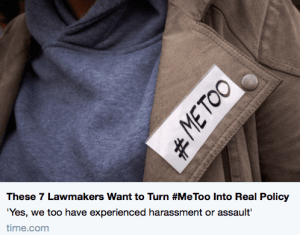
Adding to the momentum of Teresa Tanzi and other state legislators, Time Magazine is spotlighting 7 female legislators from across the country who are collectively voicing their concerns about sexual harassment, and calling for states to lead the way with creating safer, harassment-free environments for all people.
The piece was cowritten by Rep. Gilda Cobb-Hunter, South Carolina; Rep. Daneya Esgar, Colorado; Assemblywoman Cristina Garcia, California; Sen. Sara Gelser, Oregon; Rep. Renitta Shannon, Georgia; Rep. Teresa Tanzi, Rhode Island; and Rep. Litesa Wallace, Illinois.
The news is definitely not all good. But here and there, feminist victories are being won for women and girls. This past week in my home state of Li’l Rhody, we saw a sexual harassment scandal in the state capital blossom into a resignation of an offensive ranking Democratic party official, Joe DeLorenzo. As representative Teresa Tanzi said on Facebook regarding DeLorenzo’s resignation: “This is how we do it. Stand up, speak up and do so relentlessly. And unapologetically.”
Some feminist victories: Teresa Tanzi, a state legislator in Rhode Island, recently disclosed about fellow lawmakers’ sexual harassment of her. This led party Vice Chair Joe DeLorenzo to make sexist and offensive comments. As the Democratic Women’s Caucus hustled to call an emergency meeting to oust DeLorenzo, he resigned
Another feminist victories: And then there is the matter of The New Republic’s thirty-year veteran Literary Editor, Leon Weiseltier, who we now know delighted in sexually humiliating women on a daily basis. Thanks to Laurene Powell Jobs, Mr. Weiseltier will no longer be pioneering a new publication called Ideas, since it appears his sexist and misogynist ideas and behavior are part of the problem.
Tomorrow at Georgetown University, a new nonprofit called Women on the Map will launch. WOMAP is a digital network which seeks to advance women in technology and digital affairs.
It’s always good to start the week learning about the launch of a new gender equality nonprofit. Tomorrow at Georgetown University, Women on the Map (WOMAP), an international, nonprofit organization dedicated to advancing the role of women and girls in fields of technology and foreign affairs, will officially launch. To celebrate the launch, WOMAP will host an expert panel discussion on how technology can empower women and girls. Following the panel, a photo exhibition will be unveiled which celebrates the history of female trailblazers from around the world who have contributed to women’s rights, peace and security as well as international business, development, diplomacy, and public service.
“Our aim is to provide guidance, resources and tools that will both strengthen and promote women’s networks on campus and beyond,” said Zoe Dauth, WOMAP founding director. The new nonprofit will have the support of the Georgetown Women’s Alliance, Georgetown Global Engagement, Gelardin New Media Center, and the School of Foreign Service Global Career Center.
Gwen K. Young, director of the Global Women’s Leadership Initiative and the Women in Public Service Project will moderate the panel discussion. Other featured speakers include Ria Bailey Galvis from Global Economic Policy Team, Google, Inc., Victoria Espinel, President and CEO of The Software Alliance, Prachi Vakharia, managing director of Womanium, and Lisa Singh, Associate Professor of Computer Science at Georgetown University.
Every time a new nonprofit for gender equality is developed, particularly in a place of such important thought leadership as Georgetown University, it is cause for celebration. The organization promises to explore new ways technology can empower women and girls, particularly shining a spotlight on financial inclusion and female entrepreneurship.
“We are proud of the attributes that make WOMAP a distinct and singularly effective organization,” said Dauth in a press release announcing the launch. “We are both young and intergenerational, dedicated to global citizenship and the full inclusion of the voices and perspectives of women and girls in decisions and policies affecting societies worldwide. Our mission and goals align with key components of the 2030 UN Sustainable Development Goals.”
Philanthropy Women pages have been viewed thousands of times, and our spotlight organizations are enjoying more media attention.
Dear Faithful Readers of Philanthropy Women,
First, of course, thank you for reading. You are bravely joining me on the sometimes harrowing adventure of learning about gender equality philanthropy. I thank you for joining me on this journey.
Also, thank you to our sponsors, Ruth Ann Harnisch and Emily Nielsen Jones. You have provided an amazing opportunity to advance the knowledge and strategy of progressive women’s philanthropy, and for that you are wholeheartedly thanked.
Thank you, as well, to our writers — Ariel Dougherty, Jill Silos-Rooney, Tim Lehnert, Kathy LeMay, Susan Tacent, Betsy McKinney, and Emily Nielsen Jones. Your work reading, interviewing, thinking, and writing about women’s philanthropy has resulted in my receiving tons of positive correspondence about our content. The internal numbers also validate that we are making an impact.
The numbers show that our audience is primarily female on Google analytics. Our Twitter analytics indicate that our audience is comprised largely of progressive foundations, nonprofits, fundraising professionals, and technology specialists. This information is relevant to the theory that Philanthropy Women is helping high level foundation and philanthropy leaders access needed information. Many philanthropy organizations interact with us on social media in a positive way, amplifying and retweeting important content.
Our data also shows that our spotlight organizations are clearly enjoying more media attention as a result of our efforts. Women Thrive, WDN, and the Global Fund for Women, are all receiving a healthy percentage of click-throughs as a result of our presence.
Finally, in terms of our growing authority online, our work has been cited and linked to by the UCLA School of Law Blog, Philanthropy New York multiple times, and many other high level places such as Maverick Collective, Women for Afghan Women, and Giving Compass. We have a large and growing presence on social media, as indicated by the high number of referrals from Facebook, LinkedIn, Twitter, and other social media. In addition, I have received high praise from many foundation staff about our writers and our content.
So, all this is to say that Philanthropy Women is successfully growing, and, I believe, making the conversation on gender equality philanthropy richer and more relevant. But I believe we can do more. I hope you will keep reading as we work to grow our impact. We have ambitious, but, I believe, achievable goals. Best, KierstenRead More
Xiomara Corpeño is the Director of Capacity Building for theGroundswell Fund.
Editor’s Note: The following opinion piece by Xiomara Corpeño is part of a series being provided by Philanthropy Women to help identify and address growing threats to global human rights, particularly for vulnerable groups.
Several weeks ago, I woke up to the sound of my mother’s TV broadcasting the local morning news. “Breaking News! President Trump has reinstated a ban on Transgender troops this morning.” The White House later issued policy guidelines titled, A Guidance Policy for Open Transgender Service Phase Out, which would impact 15,000 trans service members.
Trump’s transgender ban is bigger than the right to serve in the U.S. military. It is part of a longer trajectory by right-wing forces aiming tofurther oppress and denigrate trans people.
This pie chart, produced by Equal Measures 2030, shows that many policymakers in the development sector do not have full knowledge of the Sustainable Development Goals.
Timing couldn’t be better. Today, the Bill & Melinda Gates Foundation announced it will give $20 million over the next three years to empower women’s organizations globally.
The news comes on the same day that Equal Measures 2030 released a Gender Report along with the Gates Foundation and ONE Campaign Coalition at the United Nations General Assembly, taking place this week in New York.
Some of the new funding from the Gates Foundation will go toward better research and training, as well as multiplying support for grassroots activism in the gender equality sector of development.
It couldn’t be clearer. Democrats like Obama and Clinton increased women in cabinet leadership. Republicans decreased this leadership. Graph courtesy of Pew Research Center’s Data on Women Leaders.
One big step forward for the Republican party, one big step backward for women leaders in politics. The graph here kind of says it all — we’re back to a Republican president and low, low numbers of women in cabinet leadership positions.
The Pew Research Center recently presented some of the longitudinal data on women’s growing roles in business and political leadership, and the full report is worth checking out.
Another thing you’ll notice on the graph: the percentage of women in cabinet positions under President Bill Clinton was higher both terms (31.8% for his first term and 40.9% for his second term) than the percentage of women in cabinet positions for Obama’s two terms (30.4% for his first term and 34.8% for his second term). Sigh. Returning to the Clinton dynasty is starting to look better all the time, particularly for women’s leadership.
Ashindi Maxton is a Senior Advisor and funding strategist for the Women Donors Network (WDN) with extensive work in democratic reform, racial justice, and education.
Editor’s Note: This is an editorial by Ashindi Maxton, who is a Senior Advisor for the Women Donors Network (WDN), one of our Spotlight Organizations. The editorial tells the story of how WDN and its allies have been able to effectively bring in more partners to fund the resistance. As Ms. Maxton points out, the Threshold Fund and the Democracy Alliance joined WDN and Solidaire to expand the Emergent Fund, amplifying the ability of that fund to protect and empower marginalized communities.
From Ashindi Maxton:
Philanthropy in the U.S. has never faced a moment quite like this one. New threats loom larger over one community after another in steady sequence and core norms of equity and democracy feel suddenly unstable.
Muslim-Americans face hate crimes and travel bans. Immigrant communities face criminalization and deportations. Women face attacks on reproductive rights. Black and Latino communities face attacks on civil liberties, including voting rights and police violence. LGBTQ communities face a loss of the most basic protections in employment and public safety.
As the level of threats we are facing increases, philanthropy must also elevate our level of response. The philanthropic community cannot meet this rapid barrage of unpredictable threats using our traditional models. Instead, we must question some of our own core assumptions.
A few best practices we could begin to question include funding driven by rigid long-term planning, extensive organization vetting, and decisions made entirely by donors or foundation staff who are removed from the crises at hand. We have to ask ourselves if our funding models seize the tremendous opportunity of the historical and political moment.
The Women Donors Network (WDN) and Solidaire, two networks of individual donors committed to funding movements for racial and social justice, shared a key question, “How can our work rise to the level of these crises?”
Two driving principles for our response: responding at the speed of the threats and placing radical trust in the threatened communities to develop their own solutions.
With these principles as the foundation, we built a funding partnership for rapid response called “The Emergent Fund.” The name refers to “emergent strategy,” solutions that fluidly adapt to rapidly changing conditions. Our shared vision was for the Emergent Fund to support the work of threatened communities to build their own new reality — one that emerges on the other side of crisis and supports organizing that uses the energy of the moment to build powerful new thinking as envisioned by community leaders.
Foundation staff and wealthy donors often do not reflect the communities most at risk in this moment. Mainstream philanthropy is anchored in a conviction that people with advanced degrees and sophisticated titles are best positioned to solve social problems although they are the furthest removed from impacted communities. Knowledge of those communities is too often considered irrelevant in hiring or decisionmaking.
The Emergent Fund, on the contrary, was based on the premise that expertise lives in the communities we want to support.
The process we used to ensure that the expertise of community members drives and informs our funding decisions was steeped in networking with community leaders.
We started by calling the organizers and community leaders, most affected by today’s political moment, that we knew and asked about needs and approaches to this work and criteria we could use to allocate funding.
Next, we formed a brilliant decision-making advisory council of eleven well-respected and networked community leaders and funder representatives with community organizing backgrounds. This group of mostly women included Latinx, Black, Asian, Arab-American, Muslim, Native, White, and LGBTQ members.
We designed an easy application form, available on our website for anyone to apply, based on our mutually agreed on criteria.
Finally, we asked a second set of diverse activist leaders from across many communities to serve as a Nominations Network, to let others know about the Emergent Fund, to vet strong proposals, and to provide feedback to inform funding decisions.
This model, adapted from other models like the North Star fund and Marguerite Casey Foundation, which have been doing activist advised funding for many years, was based on curating thoughtful decision-makers with expertise in the communities we wanted to support. In every conversation, we learned about critical dynamics previously overlooked or ignored by other philanthropy colleagues.
Two additional networks of progressive donors, the Threshold Fund and the Democracy Alliance, joined our effort. In the first few months of 2017, their individual donors helped to raise over one million dollars allocated directly to communities most in need.
As we reflect on the lessons learned from the initial launch of the Emergent Fund, one thing is clear: any funder concerned with social change should be grappling to answer this question, “Who is best equipped to solve the challenges facing the most threatened communities?”
Philanthropy cannot presume expertise over the people whose lives are most directly impacted in this moment. Rising to historical moments should mean letting go of practices that have not served us or these communities well. Now is the time to experiment with and adopt new funding and leadership models led by people forming responses and vision from their own lived experience.
# # #
Ashindi Maxton is a senior advisor and funding strategist for the Women Donors Network (WDN) with extensive work in democratic reform, racial justice, and education. The Women Donors Network, a community of more than 200 progressive women donors who invest their energy, strategic savvy, and philanthropic dollars to build a just and fair world.
Editor’s Note: To learn more about becoming a Philanthropy Women Spotlight Organization, please contact us.Read More
Groundswell Fund is a 2017 award winner of the National Committee on Responsive Philanthropy’s IMPACT Award.
On August 29, Groundswell Fund announced its selection by the National Committee for Responsive Philanthropy as a 2017 recipient of NCRP’s Impact Award. On September 18, Groundswell Fund will join three other Impact Award recipients in New Orleans at the sold-out CHANGE Philanthropy Unity Summit to receive the “Smashing Silos” Award for intersectional grantmaking.
“Receiving the Smashing Silos award means the tides are turning,” said Groundswell Executive Director Vanessa Daniel. “The leaders and organizations we support are on the front lines of every major issue we face right now. They bring the lived experience, the knowledge, the strategy and the vision our movements need.”
The “Smashing Silos” Award is validation of Groundswell’s fast-growing approach, which prioritizes women of color, low-income women and transgender people. Groundswell Fund is one of four recipients of the prestigious NCRP award. The other awardees are the Foundation for Louisiana which will receive the “Mover and Shaker” award for bold peer organizing, Meyer Memorial Trust will receive the “Changing Course” Award for incorporating feedback, and Solutions Project will receive the “Get Up, Stand Up” Award for rapid-response grantmaking.
This is the 5th Anniversary of NCRP’s Impact Awards. NCRP’s mission is to promote philanthropic responsiveness to the needs of underserved communities, as well as to enhance philanthropic accountability and effectiveness. The Impact Awards honor top grantmakers committed to diversity and inclusion that strengthens marginalized communities. NCRP has given out 19 Impact Awards since 2013. A full list of past NCRP Impact Awardees is available here.
Based in Oakland, California, Groundswell Fund has made major advances for funding the resistance, particularly around the needs of women of color and LGBTQ people of color. Its Liberation Fund, which we wrote about here, has now secured $500,000 in funding for its first set of grants, and has recruited “15 prominent advisors from across environmental, racial and economic justice, to immigrant, Native and transgender rights,” according to the press release about the award. Groundswell plans to announce its first set of grantees this Fall 2017.
Childcare Impact Assessment, a new report from Ms. Foundation for Women, links up ways to effectively support women in the workforce: better wages and childcare access.
We know that childcare needs to be valued and supported for society to thrive. Yet, time and again, we leave parents, particularly low-income and young parents, out of the picture for access to childcare.
Today, a new study released by the Ms. Foundation for Women validated that state and local officials need to take the reigns and steer their community toward economic growth by funding access to childcare.
“Our approach has not only helped the local organizations achieve policy gains, but also provided necessary resources to develop intersectional leadership in grassroots organizations,” said Aleyamma Mathew, Director of Economic Justice at the Ms. Foundation for Women. “To achieve economic security in the Trump era, we have to win on the state and local level,” she added.
 Just as I was remarking on Teresa Tanzi’s courage and how it led to an important victory for women and girls, comes news that the episode is bearing more fruit in terms of raising awareness and taking action.


