Hello there, my philanthro-friends. Welcome to another week of feminist giving updates, as well as other revelations in the world of gender equality news.
Holly Madison, former girlfriend of Hugh Hefner and creator and star of Girls Next Door, discusses her diagnosis of Aspergers in Secrets of Playboy, and how she was drawn to living at the Playboy mansion early on because it gave her a sense of community. (Image credit: Secrets of Playboy)
This week, I did it. I binge-watched the first six episodes of Secrets of Playboy on A&E.
I did it for a lot of reasons. First, because I care about women, especially women who have survived trauma and are trying to make peace with that trauma and with the world that allowed it to happen.
As we continue to celebrate Black History Month, one of the highlights so far has been the February 2022 edition of Meet the Philanthropist, my virtual interview series with leading women philanthropists and leaders in philanthropy.
Kendra Fox-Davis, Chief Program Officer, Rosenberg Foundation (Image credit: Kendra Fox-Davis)
This time, I had the distinct pleasure of a discussion with Chief Program Officer of California’s Rosenberg Foundation, Kendra Fox-Davis. I was thrilled to speak to Kendra, who is returning to have this conversation as a bit of a follow-up from the WOC Symposium in November. Everything she shared was so inspiring, and I knew she was the perfect person with whom to explore, remember, and embrace for Black History Month, particularly in the realm of fundraising and philanthropy.
Well hello, my philanthro-lovelies! I hope you are doing well, and are ready to dive into some more feminist giving news!
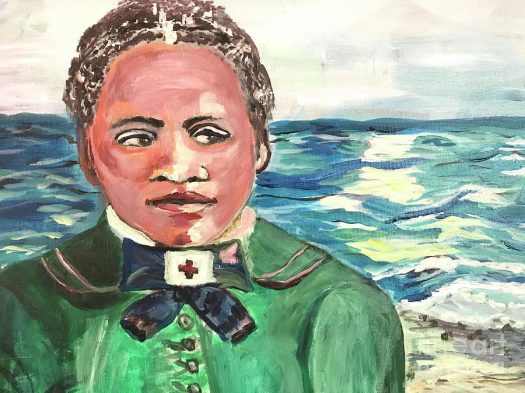
Happy Black History Month! This painting is entitled “Biddy Mason, 1852, Los Angeles” and features one of the first Black women to own property in Los Angeles, Biddy Mason. The year is 1852 in this depiction. Biddy Mason is age 34 and not yet freed. She would go on to petition for her freedom in California in 1856, and received her certificate of emancipation in 1860. Before and after her emancipation, Biddy Mason practiced as a nurse and mid-wife. (Image credit: Kiersten Marek)
Today I’d like to start with a quote from MacKenzie Scott, who has outstripped her ex-husband’s lifetime of giving in just two years. Here are her words from when she made her promise to fulfill The Giving Pledge:
Editor’s Note: I wrote this post a year ago, but I 100% endorse it again as the best use of your Giving Tuesday resources.
Since starting Philanthropy Women, we have chosen to embrace Giving Tuesday each year in different ways, but always as a great opportunity to give back to women. This year we are celebrating Giving Tuesday by naming our Top 10 Picks for feminist giving for the day. We hope you enjoy the list and relish the experience of making an intentional gift to one or all of them on Giving Tuesday.
Did you know that research from the Women’s Philanthropy Institute showed that in 2018, women gave the majority, 64.9%, of dollars donated on Giving Tuesday? Perhaps that’s because women generally look for opportunities to give, and when a new holiday is established where the sole purpose is to give to charity, women are all over it.
#1 Women’s Fund of Rhode Island or Your State’s Women’s Fund
There is really no better bang for your charity buck than your own local women’s fund. Ours here in Rhode Island does a fantastic job of gender equality education and training, civic engagement, and grantmaking. Imagine if every adult in Rhode Island (roughly 800,000 people) gave just $1 to the Women’s Foundation of Rhode Island? That would mean $800,000 in resources that would exponentially increase the education, engagement, and grantmaking for one of the most influential women’s organizations in the state. Then we could really see what WFRI is capable of in terms of helping our state move toward gender equality. If you don’t live in Rhode Island, you can find your local women’s fund by visiting the Women’s Funding Network where most state and regional women’s funds are members.
Editor’s Note: This interview in our Feminist Giving IRL series featuresSara Lomelin, executive director of Philanthropy Together.
Sara Lomelin, courtesy of Sara Lomelin
1. What do you wish you had known when you started out in your profession?
When I switched careers 12 years ago, I didn’t understand the power dynamics and barriers that exist for grassroots nonprofits. I wish I knew the intricacies of philanthropy and why such large gaps exist between those who need funding and those who receive. I now see that collectively, we are moving the needle to shift philanthropy, but it’s happening very slowly.
While I wish I’d entered on this path sooner, I am proud to now devote my career to giving circles because I believe this model is the most dynamic way to liberate capital to nonprofit leaders who know what solutions are best for their communities. Giving circles are filled with everyday givers coming together to diversify and democratize philanthropy. These are the voices that have historically been excluded by mainstream philanthropy and the voices that will break down these existing power dynamics and eliminate barriers to much-needed funding for grassroots leaders.
It’s finally happening: America is charting its course as a nation to remedy our problems with gender equity and equality. What is contained in the momentous document, and how will it affect funding for gender issues?
The Biden-Harris administration’s Gender Policy Council recently released the country’s first National Strategy on Gender Equity and Equality. (Image credit: White House Report)
The President and Vice President begin the document by locating the issue in our current context of heightened stakes for women and girls in the US and across the globe:
This document, the first-ever United States government strategy on gender equity and equality, is a part of that noble American tradition [of valuing equality]. It comes at an inflection point for the economic security, safety, health, and well-being of women and girls in our nation and around the globe. COVID-19 has exacerbated preexisting economic, health, and caregiving crises that disproportionately impacted women and girls long before the pandemic struck. Following the worst economic collapse since the Great Depression, women’s participation in the American labor force plummeted to its lowest level in over 30 years. Rates of gender-based violence have risen significantly, and racial and ethnic inequity has deepened.
Texas Women’s Foundation, a powerhouse for women and girls in Texas, raised more than $1 million at their 36th Annual Luncheon
Guest speakers Cleo Wade and Angie Thomas discussed the power of women and girls finding their voices with moderator Laysha Ward, Target executive vice president and chief external engagement officer. (Image credit: TXWF)
Across Texas, groups convened to watch in livestream mini-parties, including 96 students and teachers from Brookhaven College, as the Texas Women’s Foundation held its Annual Luncheon online. Presented by the Dallas Mavericks, the event raised more than $1 million and had a total audience of over 4,000.
The event, entitled My Voice. My Story. Every Woman’s Power to Build Compassion and Community, brought together leaders across society to talk about the value of increasing the wellbeing of women and girls in Texas and beyond.
How The Fifteen Percent Pledge is Pushing for Better Diversity on Store Shelves
Following the horrific murder of George Floyd, Canadian-born director, activist, and fashion designer Aurora James decided she needed to do something to make a difference. Act after act of police brutality with little to no repercussions for the perpetrators left the Black community in a state of perpetual fear and disgust. George Floyd’s death on May 20, 2020 also came at the same time as the height of the pandemic, which disproportionately affected Black businesses.
James’s response was to found the Fifteen Percent Pledge, which has since gone on to bring on board over two dozen major corporations. According to James’s website, the impact of the Fifteen Percent Pledge has been significant, “effectively diverting over $5B in capital to Black entrepreneurs in the United States” within the first year.
As our young women come up in the world, they face a deluge of information online, much of which is contributing to their sense of safety, or lack thereof. A new report from Plan International helps to break down the ways that online disinformation is impacting the lives of girls ages 15 to 24 around the world.
The Truth Gap, a new report from Plan International, helps identify the ways that young women and girls are being impacted by online disinformation. (Image credit: Plan International)
The report, The Truth Gap, helps to explain how girls and young women in 33 countries are experiencing information they find online. The report discovered that one in five girls (20%) feels unsafe due to false information that comes from the internet.
Editor’s Note: This interview in our Feminist Giving IRL series featuresTyeshia Wilson, director of engagement for Philanthropy Together.
Tyeshia Wilson, courtesy of Tyeshia Wilson
1. What do you wish you had known when you started out in your profession?
Working in philanthropy is one of the most rewarding and self-fulfilling careers, ever. I’m altruistic, I’m a humanitarian, and I’m passionate about service. Looking back, I only wish I had been exposed to the idea of a career in philanthropy earlier. If I was aware of this alignment between my heart and the work of this field, I would have started in this profession much sooner and likely pursued philanthropic studies in school.