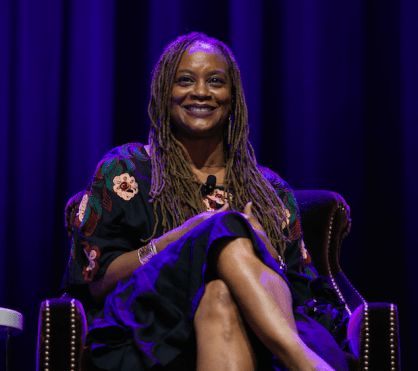
Kamala Harris: “We’re Gonna Get It Done.”

Editor’s Note: This post originally appeared on August 18, 2020, before Kamala Harris became the first female Vice President of the United States.

“We’re gonna get it done.” These were some of the first words spoken by Vice Presidential Candidate Kamala Harris in her phenomenal half-hour interview with Errin Haines, Editor-at-Large for the 19th, during the 19th Represents Summit on Friday. Harris’s plans to “get it done” refer to the upcoming Presidential election, and her goal to join Joe Biden in leading the U.S. out of one of its worst crisis periods in history.

Vice Presidential candidate Kamala Harris spoke with Errin Haines of The 19th on Friday, August 14th, giving details of her experience becoming the first woman of color nominated to the U.S. Presidential ticket. (Image Credit: The 19th video, Youtube)

Haines began the interview by asking what it was like for Kamala Harris to be in competition with women she respected and worked with, other candidates who were running for President and were in the lead to be asked to fill Biden’s ticket for the Vice President spot.

Read More

Equal Rights Amendment Can’t Wait in Time of COVID

Editor’s Note: This post urging passage of the Equal Rights Amendment was originally published on September 3, 2020.

Three weeks ago, I was elected as Board Chair of the Equal Rights Amendment Fund for Women’s Equality. As a funder and champion of women’s rights and economic justice, this call to step up could not have come at a more urgent time. 

equal rights amendment
The ERA Coalition is the sister organization to the Equal Rights Amendment Fund for Women’s Equality. (Image Credit: ERA Coalition)

Each one of us has had many moments of reckoning during COVID-19. But as women of color, we have seen that COVID has treated us differently from the rest. Race has been identified as a co-morbidity and a risk factor, just like diabetes or heart disease. Our healthcare systems, our educational systems, and our systems for protecting essential workers are all struggling mightily against a dangerous and mysterious disease. Basic rights and systems have been demolished for women, and women of color are being particularly hard-hit, facing higher rates of job loss while also being expected to bear more responsibility for caregiving and educating children.

Read More

Intersectional Philanthropy: A Conversation with Suzanne Lerner

Editor’s Note: This Q&A was created with the assistance and guidance of Claudia Carasso, Founder and Principal of Elastic Minds. This post was originally published on September 10, 2020.

After our July webinar, “Lack of Funding for Women and Girls of Color: What Donors Can Do,” we had a chance to speak further with our guest, Suzanne Lerner, on her approach to intersectional gender lens philanthropy.

Suzanne Lerner, Co-Founder of clothing brand Michael Stars, is an activist entrepreneur with a primary focus on gender & racial equality, and the economic empowerment of women & girls. (Image Credit: Suzanne Lerner)

The conversation below explores Lerner’s experience as a philanthropist, business leader, and activist entrepreneur, as well as what other funders and company leaders can do to advance an intersectional focus in their approaches to philanthropy.

Read More

Finance Expert: Minimize Charity. Maximize Gender Lens Investing


Editor’s Note: This article was originally published on November 10, 2019.

Tracy Gray has something important to tell women about their philanthropy: do less of it. It’s not the usual message that donors get from the world, and it’s not the usual message here at Philanthropy Women, either. But the context of this message comes from Gray’s conviction that the quicker we grow women’s wealth through gender lens investing, the quicker we will move toward a better society.

Tracy Gray is the Founder of the 22 Fund, a growth equity investment firm that seeks to create more quality employment opportunities for women and people of color. (Photo credit: anitab.org)

“Take some of your money out of charity and put it into women-owned or women-led businesses,” Gray advised women donors, in a recent phone chat with Philanthropy Women.

Read More

LaTosha Brown: The Time is Now to Fund Black Women and Girls

Editor’s Note: This post was originally published on February 11, 2021.

This past summer, before the announcement of Kamala Harris as the nominee for Vice President, Latosha Brown received a phone call from the soon-to-be Vice President. The phone call was in response to an article Brown had published in Essence called Reimagining An America That Uplifts Black Girls. Vice President Kamala Harris wanted Latosha Brown to know that she shared her hope that America could reimagine the country so that all girls will be lifted up.

LaTosha Brown
LaTosha Brown shares her expertise as a movement organizer and leader, calling for more just and equitable funding for Black women and girls. ( Image Credit: LaTosha Brown)

“Vice President Kamala Harris called me to say she had read the article, and that she too was committed to women and girls all across the country,” said Brown, in a recent phone interview with Philanthropy Women.

Read More

Sexual Assault Prevention Orgs and Funders: A New Updated List

Editor’s Note: This post was originally published on October 19, 2017 and has been updated to include more organizations and funders addressing sexual assault prevention.

It’s On Us is one of the organizations that receives NFL support to help educate the public about how to take responsibility for consensual sex. (Image credit: It’s On Us)

In the age of #MeToo, it will probably come as little surprise to learn that I am also a survivor of sexual assault. I don’t want to go into the details here (if you want the full story on that, you can watch this video). When I became a social worker, I chose to build my professional life around helping survivors both heal and fight for justice. Over the past 25 years, I have treated hundreds of sexual assault survivors and their families. I have helped people achieve justice, and I have also seen many survivors choose not to engage with the justice system for fear of being further traumatized. Sadly, that fear is not unrealistic.

Read More

AOC: The Powerful Voice of Feminist Giving In Real Life

Editor’s Note: the following post was originally published on February 3, 2021.

Here at Philanthropy Women, we started a series called Feminist Giving In Real Life (F-GIRL) to provide a platform for women leaders at all levels who are giving in a feminist way. This giving can happen through donations and funding strategy, through professional excellence, and/or through leadership efforts in the community. Feminist giving is a form of leadership that has special impact because it often combines deeply personal experience and significantly political thinking and acting.

AOC
AOC became tearful as she disclosed that she is a survivor or sexual assault. In a 90 minute video on Instagram, AOC discussed the ways in which the January 6 riots constituted a form of trauma related to sexual trauma experienced by herself and many other Americans. (Image Credit: AOC on Instagram

Yesterday, Alexandria Ocasio-Cortez performed what I would call a supreme act of feminist giving. When AOC spoke out against the January 6th riots and connected these riots to her experience of being sexually traumatized, she simultaneously stood up for every human who has experience sexual assault, and challenged the largest political body of our country to acknowledge how the January 6th riots are part of a continuum of pervasive violence against women, people of color, and other marginalized groups.

Read More

The 12 Most Promising Trends in Women’s Philanthropy

Editor’s Note: This post on feminist giving trends was originally published on August 3, 2020.

Since I launched Philanthropy Women in 2017, and even before then, I have been paying close attention to the feminist giving trends, as well as the big plays and strategy shifts, happening in feminist giving. For that reason, I thought it might be helpful to enumerate some of those gender equality giving trends and other happenings, and flesh out what they mean both now and for the future of philanthropy.

feminist giving
State-based women’s funds such are getting more powerful as large foundations like the Bill & Melinda Gates Foundation begin to recognize the value of their existing infrastructure to leverage social change. (Image credit: Women’s Foundation California)

1. Women Funders Are Getting More Ambitious With Their Strategies

I see women funders getting more ambitious with their strategies in many different ways, both in terms of the subjects they will fund as well as the approaches they are willing to try. This means they are doing bolder things with their money, which often translates into helping our culture to become more inclusive and knowledgeable about difference. For example, Mona Sinha, Chair of the Women Moving Millions Board, has done some amazing work lately supporting the documentary Disclosure. This film does groundbreaking work in terms of exploring the growing world of gender transition, helping this community to be seen and valued by society. Being unafraid to cross the barrier and fund the LGBTQ community is just one of the many bold strategies that more feminist funders are adopting more frequently.

Read More

GLSEN Board Adds New Experts Imara Jones and Malachi Garza

On July 14th, the Gay, Lesbian, and Straight Education Network (GLSEN) welcomed Imara Jones and Malachi Garza to their Board of Directors. Jones, recently announced as a Nathan Cummings Fellow, and Garza, organizing director of Solidaire Network, join a robust team of educators, funders, and educator advocates devoted to creating affirming educational environments for LGBTQ+ youth.

Image Credit: GLSEN, Twitter

About GLSEN

Founded in 1990 by a group of teachers who identified educators’ role in creating a safe and learning-conducive environment for LGBTQ+ students, GLSEN leverages educational activism, extensive research, and student-led movements to uplift evidence-based solutions for LGBTQ+ youth.

Read More

Kimberlé Crenshaw: How to Fund Women and Girls of Color

Editor’s Note: This interview was originally published in July, 2017.

I have spent the past few years observing, writing about, and getting more involved in the world of women’s philanthropy. During that time, multiple experts have referred to the work of Kimberlé Crenshaw as being essential to the changes we now see going on in philanthropy, with more efforts to apply both a gender and race lens when framing problems and funding new strategies.

Kimberle Crenshaw
Kimberlé Crenshaw, Professor, Columbia Law School and UCLA Law School, Co-Founder, African American Policy Forum

Indeed, with her scholarship, advocacy, and legal expertise, Crenshaw has helped build and disseminate whole new areas of knowledge including critical race theory and intersectional theory. These concepts have helped philanthropists like Peter Buffett and organizations like the NoVo Foundation apply an inclusive gender and race lens that values and addresses the needs of women and girls of color in the United States.

Read More